
Your Passion, Our Protection
More than legal protection, we’re true partners to those shaping culture through creativity.






"Royalty-free" is one of the most misunderstood terms in the content creation industry. Brands, agencies, and social media teams routinely assume that royalty-free music and stock footage can be used anywhere, in any context, for any purpose—and they are consistently wrong. This misunderstanding has led to six-figure copyright settlements and it continues to generate legal exposure across every major platform.
 Gryffindor, CC BY-SA 3.0, via Wikimedia Commons
The term "royalty-free" refers to the payment structure, not the absence of copyright protection. Royalty-free music is fully protected by copyright law. The distinction is that instead of paying a royalty every time the music is used (the traditional model), the licensee pays a one-time fee—or a recurring subscription fee—for the right to use the music within a defined scope.
Royalty-free does not mean:
Epidemic Sound, a leading royalty-free music platform, explicitly lists ten common myths about music licensing, leading with: "Royalty-free music means no additional fees"—but notes this only applies within the specific license terms purchased. Use the music outside those terms and you are infringing, regardless of what you paid.
Stock music licenses are scoped by use case, platform, audience size, commercial purpose, and sometimes even specific industries. A license purchased for a YouTube video does not automatically cover:
This is the B-roll music trap. A social media agency purchases a subscription to a stock music library, downloads tracks for use in client videos, and posts them across TikTok, Instagram, YouTube, and Facebook—assuming the subscription covers everything. If the subscription terms limit commercial use to the subscriber's own brand content only, using that music in client-facing commercial content may constitute infringement of the license agreement and, by extension, copyright law.
.jpg) Spektiv.org, CC BY-SA 4.0, via Wikimedia Commons
Spektiv.org, CC BY-SA 4.0, via Wikimedia Commons
The same logic applies to stock video footage. Stock footage licenses from services like Shutterstock, Getty Images, and Adobe Stock are scoped by resolution, distribution platform, number of impressions, and commercial intent. A clip licensed for "web use" may not cover broadcast advertising. A clip licensed for editorial use—news, documentary, journalism—explicitly prohibits commercial advertising use.
Many brands use B-roll footage from free services like Pexels or Unsplash, which offer broad Creative Commons licenses—but even these have conditions. Some CC licenses prohibit commercial use (CC BY-NC), and using such footage in branded social media content violates those terms.
The problem intensifies when content moves across platforms. Music licensed for YouTube organic content may not cover the same video when it becomes a YouTube paid advertisement (Google Ads). Instagram's platform terms create a commercial/personal distinction similar to TikTok's—music from the Meta Sound Collection may be available for business accounts, but does not cover paid ads run through Meta Business Manager.
Content teams building multi-platform campaigns must verify that every piece of licensed music and footage covers every intended deployment, including organic posts, paid boosting, cross-posting, stories, reels, shorts, and any future repurposing.
Leading brands in 2025 and 2026 are implementing music and asset license tracking software—tools like Whitebalance and MatchTune—that scan social media content for copyright exposure and verify license coverage before publication. These tools treat every piece of music as a tracked asset with defined usage rights, flagging mismatches before they become lawsuits.
Practical steps for content teams:
Royalty-free is a billing model, not a permission slip. Treat it accordingly.
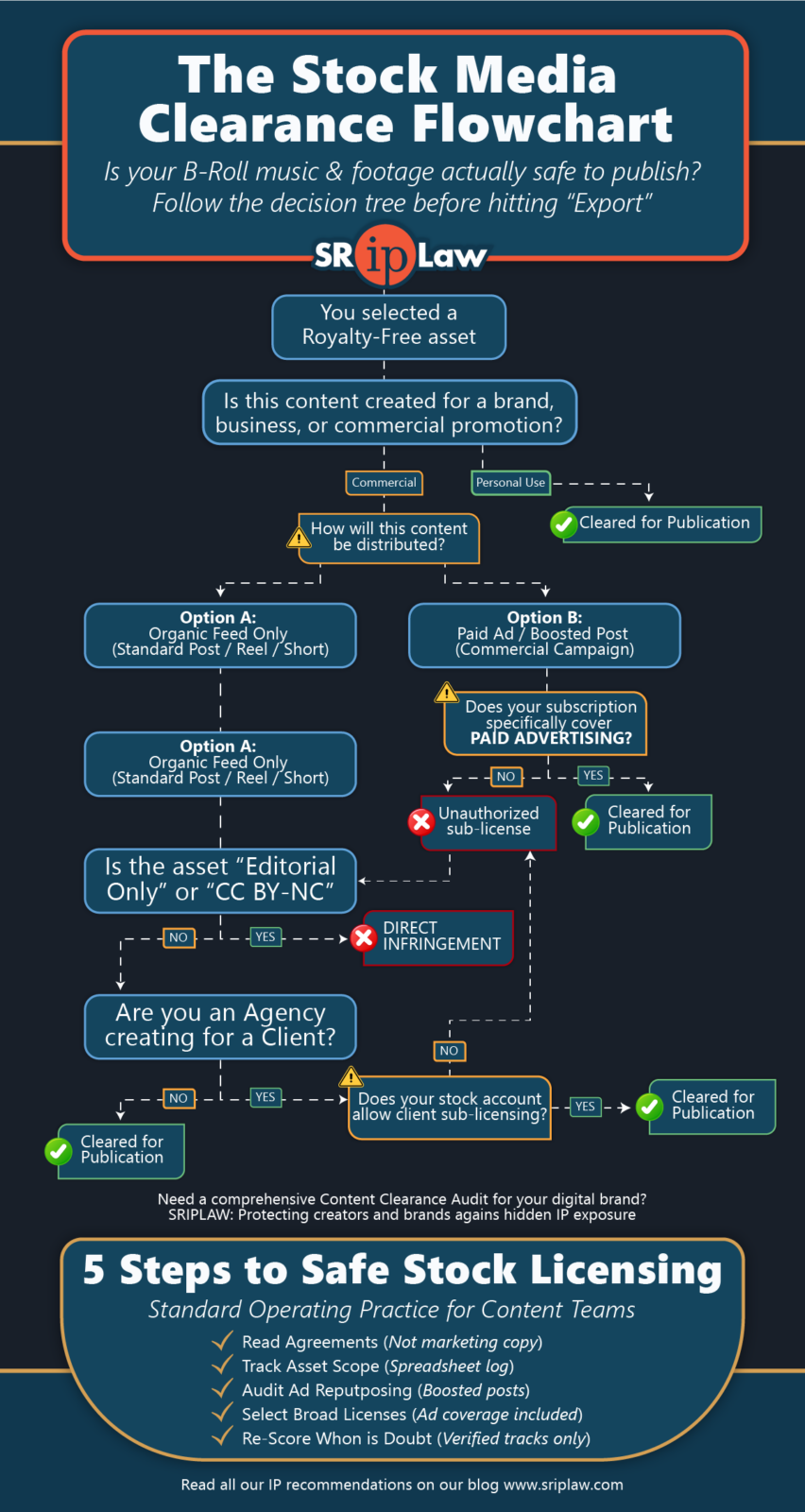
Is your background audio or B-roll safe to deploy? Follow our step-by-step decision tree below to verify asset scope across organic posts, paid ads, and third-party client distribution.Is your background audio or B-roll safe to deploy? Follow our step-by-step decision tree below to verify asset scope across organic posts, paid ads, and third-party client distribution.
Featured photo by AI25.Studio Studio on pexels
From general questions to potential IP misuse, choose the option that best fits your case.
Our team will review your submission and get back to you as soon as possible.