
Your Passion, Our Protection
More than legal protection, we’re true partners to those shaping culture through creativity.




Colombia has long been a country where copyright infringement was more likely to pay than to get punished. Proving damages was expensive, complicated, and often yielded symbolic results. That era is over. The convergence of two developments — a new statutory damages framework and a demonstrated track record of success before Colombia's specialized copyright tribunal — makes this the most favorable enforcement environment for copyright holders in the country's history.
A Specialized Court Where Applicants Win
Since 2012, Colombia's General Procedural Code granted the Dirección Nacional de Derecho de Autor (DNDA) full judicial powers to adjudicate civil copyright disputes. The DNDA's Subdirección de Asuntos Jurisdiccionales functions as a specialized copyright court, staffed by professionals with deep expertise in author's rights — something ordinary civil courts cannot offer.
A review of every published DNDA decision from 2016 through 2023 — 103 fallos in total — reveals a striking pattern: applicants succeed in 80.9% of adjudicated cases. Full, outright wins account for 72.3% of outcomes. Partial wins add another 8.5%. Defendants prevail in only 19.1% of cases. These numbers outpace applicant success rates in conventional civil litigation by a wide margin.
Even more striking: in 100% of the cases where a defendant won, the court ordered the losing applicant to pay the defendant's attorneys' fees and costs (costas and agencias en derecho). This creates a two-sided incentive structure that should focus the minds of rights holders. Filing a well-founded, properly documented claim is rewarded generously. Filing a weak or speculative claim carries real financial downside risk. The data says: if you have a solid case, you are very likely to win — and if you do not, you will pay for losing.
The Cases That Get Filed — and Why They Win
The DNDA's case docket reveals which types of infringement claims succeed most reliably. Collective management organizations — EGEDA (audiovisual producers), OSA/SAYCO-ACINPRO (music authors and performers), and ACTORES (audiovisual performers) — account for the overwhelming majority of applicant wins, typically suing hotels, cable television operators, and transportation companies for unauthorized public communication of protected works. These cases succeed at rates approaching 95%, because the legal framework is settled and the evidence is straightforward.
Individual rights holders — authors, photographers, musicians, and software developers — also succeed regularly, though at a modestly lower rate. The main risks for individual claimants are standing defects (failure to adequately document chain of title to the claimed works) and insufficient originality or similarity proof. The lesson from the case record is clear: invest in your documentation before you file.
The DNDA procedure itself has practical advantages over ordinary civil courts. It is specialized, faster, and benefits from decision-makers who understand copyright's unique technical vocabulary without needing to be educated from scratch. Injunctions and cease-and-desist orders are available alongside monetary awards. And since 2020, the DNDA has been authorized to handle up to 200 civil copyright cases per year — a significant jurisdictional expansion driven partly by demand from rights holders who recognized the tribunal's effectiveness.
.jpg)
For years, one persistent obstacle deterred many legitimate copyright claims: proving damages. Even when infringement was obvious — a hotel playing unlicensed content in every room, a bus company broadcasting music without a license, a streaming pirate rebroadcasting pay television — quantifying the precise economic harm was technically demanding, often requiring costly expert testimony, financial discovery from the infringer, and complex calculations of lost license fees and lost profits.
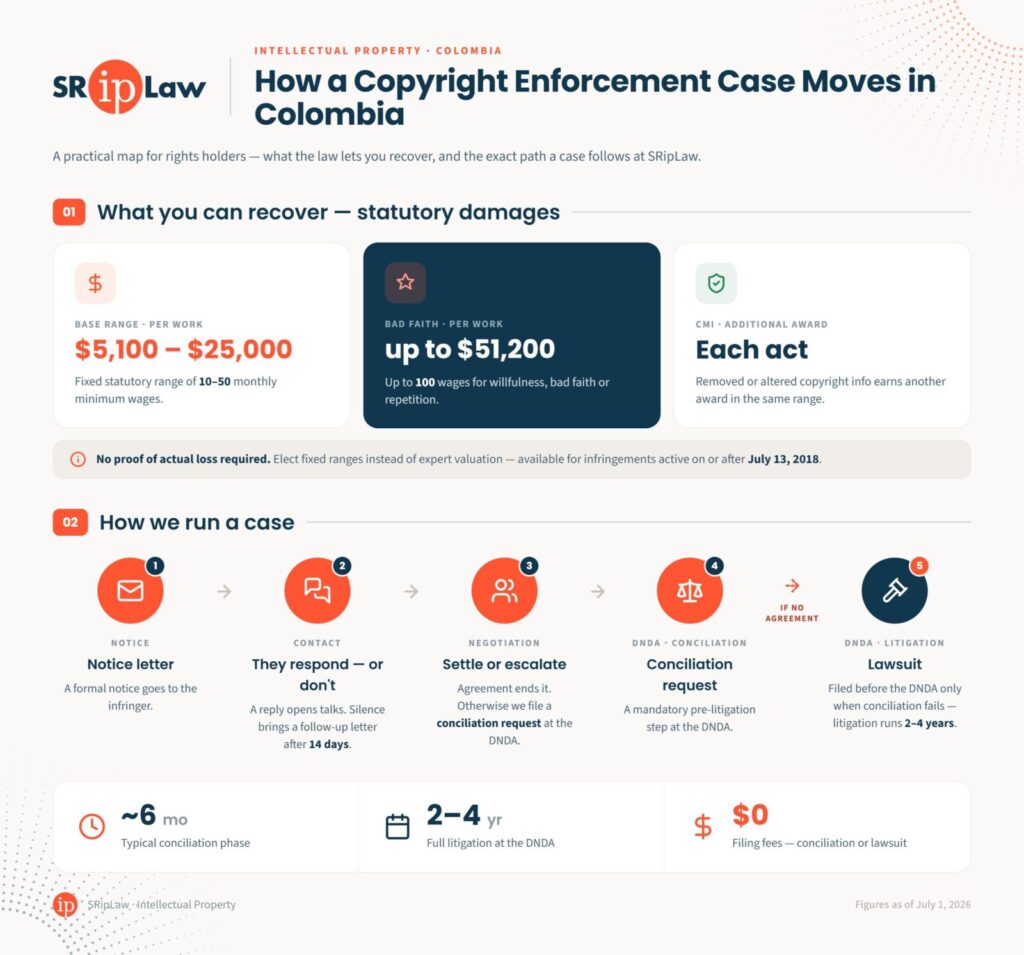
Article 32 of Law 1915 of 2018 authorized statutory damages for copyright infringement — a long-pending obligation under the U.S.-Colombia Free Trade Agreement — but left the regulatory implementation to a government decree that took eight years to arrive. That decree, Decreto 370 of April 7, 2026, finally makes statutory damages fully operational.
The framework is straightforward. At the time of filing, an applicant may elect the statutory damages regime instead of the traditional system of proving actual harm. Under the new system:
Standard range: 10 to 50 minimum monthly wages per infringed work, per infringer — at current rates, approximately COP $17.5 million to COP $87.5 million per work
Enhanced range: up to 100 SMLMV (approximately COP $175 million per work) where the court finds bad faith, wilfulness, or repeat infringement
Good-faith reduction: 1 to 10 SMLMV where the infringer demonstrates a reasonable belief that their conduct was lawful
Absolute cap: 500 SMLMV (approximately COP $875 million) for cases involving multiple works
Crucially, once infringement is proven, the applicant does not need to prove the amount of harm or the infringer's profits. The judge fixes the amount within these ranges using criteria including the nature and duration of the infringement, the commercial significance of the works, and any aggravating conduct by the infringer. This eliminates what was previously the hardest and most expensive part of copyright litigation in Colombia.
What This Means in Practice
.jpg)
The combination of an 80.9% historical win rate and a new, streamlined damages system creates a compelling enforcement calculus. An applicant who would previously have hesitated to litigate — uncertain whether provable damages would justify litigation costs — now faces a very different calculation. Infringement can be converted into a quantifiable award without the burden of complex economic proof, before a tribunal staffed by copyright specialists, in a proceeding that carries a four-in-five chance of success.
For rights holders who have been absorbing infringement losses silently — whether individual creators whose works appear online without authorization, publishers whose content is reproduced commercially, software developers whose programs are used without license, or collective management organizations whose tariff demands go ignored — the DNDA procedure now offers a realistic, accessible remedy.
The time to act is now. Rights are not self-executing. Colombia has built the enforcement infrastructure; the only remaining variable is whether rights holders choose to use it.
This article is for informational purposes only and does not constitute legal advice. For case-specific guidance, consult a qualified Colombian intellectual property attorney.
Cover Photo by Dayanna Martinez on Pexels
From general questions to potential IP misuse, choose the option that best fits your case.
Our team will review your submission and get back to you as soon as possible.